

 Yunji
YunjiIn a hotel lobby on Hong Kong Island, a delivery robot pauses outside one of the lifts as the doors open, and a guest steps out. The robot waits, and then rolls neatly inside.
The move looks simple, but it isn't. To work in the busy hotel, owned by an international chain, the robot must navigate a building that won't slow down for it.
People are often getting in the way, and it must be able to take the lift to the correct floor, and then find the right room.
The company behind the robot, Yunji, is a mainland Chinese tech business that is aiming to use Hong Kong as a springboard for successful overseas expansion.
"We aim to make our product succeed in Hong Kong, and then expand outward," says the firm's vice-president, Xie Yunpeng.
'Investing in people': Can China's new push to boost spending revive the economy?
China sets lowest economic growth target since 1991
China exports surge despite Trump tariffs
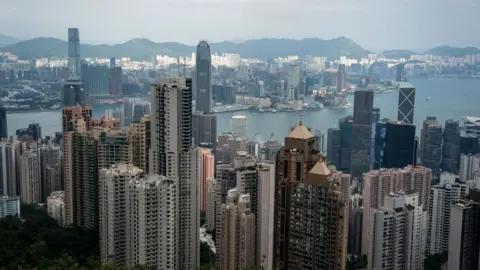
Hong Kong is becoming increasingly important to such mainland Chinese tech companies as a place to raise money, test products with international clients, and build credibility for overseas expansion.
This matters because US and European nations have grown more wary of such Chinese companies. Dubbed "China risk" by some commentators, countries fear state-led espionage and excessive Chinese domination of their tech sectors.
For mainland Chinese tech firms it means they are finding access to capital, customers and trust harder to secure in some international markets. So, they are instead looking to Hong Kong in the first instance.
Last year, the number of mainland Chinese firms listing on the Hong Kong Stock Exchange increased to 76, up from 30 in 2024, an increase of 153%, according to a report by accountancy giant PricewaterhouseCoopers.
Invest Hong Kong, the investment promotion agency for the special administrative region, has also reported a rise in the number of mainland firms it has helped to set up or expand in the territory, with innovation and technology among the biggest sectors.
 Yunji
YunjiXiaomeng Lu, a director at political consultancy Eurasia Group, says mainland Chinese tech firms are "shifting to Hong Kong" for their primary share listing as "geopolitical headwinds dampen their dreams" to float in New York.
"These days Hong Kong is their best hope to attract global investors and position themselves as a player not fully constrained by the boundary of the mainland market," she adds.
Meanwhile, Wendy Chang of the Mercator Institute for China Studies, a Germany-based think tank, says Hong Kong is "fashioning itself as a connector to the outside world for Chinese companies", with policies to speed up share flotations and help mainland firms set up operations in the city.
This increased focus on Hong Kong comes as the Chinese government in Beijing is aiming for the country to achieve more "technology self-reliance".
Significantly reducing its need for foreign hardware and software is now at the centre of its economic policy, especially regarding artificial intelligence and semiconductors.
This is a key focus of the country's new 15th Five-Year Plan, which sees technology not just as an economic priority but as a strategic one given tensions with the US.
 AFP via Getty Images
In this context, the "strategic value of Hong Kong for high-tech Chinese companies" has increased, says Paul Triolo, a Washington-based partner of global business consultancy DGA Group.
Alicia Garcia-Herrero, chief economist for Asia-Pacific at French investment bank Natixis, says that Hong Kong offers mainland firms a place where they can show that they can meet international standards while building trust with global investors and clients.
For Yunji, that means proving its robots can operate in real-world international settings. The company, which builds its service robots for hotels, hospitals and factories, listed in Hong Kong in October of last year, as it sought to widen its investor base beyond the mainland.
MiningLamp Technology, a Chinese AI software company set up its operation in Hong Kong the same month. Its founder, Wu Minghui, calls Hong Kong a "data compliance transfer station", where mainland Chinese firms like his can test how to handle cross-border data flows and build compliance processes before moving into other markets.
But even if a mainland Chinese firm is successful in Hong Kong, it can still face barriers overseas.
Governments in the US and Europe have tightened national security reviews of Chinese investments and technology, citing concerns over data access and critical infrastructure. Some countries, like the US and UK have also moved to restrict or phase out Chinese suppliers from telecoms networks.
Western nations also have broader concerns about Chinese firms' governance and transparency. The Luckin Coffee scandal remains a cautionary tale for many international investors after the Chinese company admitted fabricating sales.
The revelation saw its shares being delisted from New York's Nasdaq stock market in 2020.
Meanwhile, Hong Kong is not as appealing to international companies and investors as it once was. Since mass pro-democracy protests in 2019, authorities have imposed a sweeping national security law and new local security legislation.
Dozens of activists, opposition politicians and journalists have been arrested or jailed under security or related laws. Beijing and Hong Kong officials say the measures were necessary to restore stability and order, but critics say this has sharply curtailed political freedoms.
And Triolo says that even with a Hong Kong base, many mainland companies remain bound by evolving rules set in Beijing, from cybersecurity and data controls, to requirements for public-facing AI.
"Hong Kong is not really a geopolitical shield [for such firms]", he says, adding that it "only partially mitigates" their risks.
Read more global business storiesUkraine's urgent fight on the financial frontline
A small US grocer is calling out the lower prices at big chains
Spain's migrants welcome amnesty: 'It will help us in every way'
Deepfake attack: 'Many people could have been cheated'
World of BusinessInternational BusinessChinaHong KongChina-US relationsChina economyRelated
Germany has a shortage of workers - so it's turning to India for help
How Finnish supermarkets are central to the country's defence
India's outsourcing industry is worth $300bn. Can it survive AI?
More from the BBC3 hrs ago

Oil rises above $115 and Asia shares slide as Iran war enters fifth week
It comes after Iran-backed Houthi rebels in Yemen joined the conflict by striking Israel over the weekend.
3 hrs ago4 hrs ago
Woman deported from China over Manx passport mix-up
A woman from the Isle of Man says she was escorted back on to the plane by Chinese border guards.
4 hrs ago1 day ago
One ant for $220: The new frontier of wildlife trafficking
The craze for collecting ants takes Kenya by surprise as smugglers zone in to make a profit.
1 day ago2 days ago
'Memory of a generation': China mourns the sudden death of a controversial education influencer
The divisive 41-year-old was among the country's most prominent influencers.
2 days ago2 days ago
I escaped North Korea with my mum. Now I'm terrified she might be sent back
Geumseong survived a dangerous journey to South Korea, but his mother is stuck in a Chinese prison and may be forcibly repatriated.
2 days agoCopyright Notice
The views expressed in this article are the author's own and do not represent the position of this website.
This article is published with the author's authorization. Reproduction without permission is prohibited.















Comments