
 Getty Images
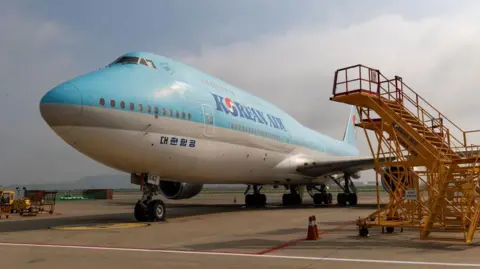
Korean Air says it is moving into emergency management mode to buffer the impact of surging jet fuel costs as the global economy is rocked by the ongoing US-Israel war with Iran.
A spokesperson for the national flag carrier said on Tuesday that it will implement "internal cost-reduction measures" to manage its finances to ensure the firm's "stability amidst rising fuel prices and global economic uncertainty".
It is the latest Asian airline to announce measures to deal with the economic impact of the Iran war.
The cost of crude oil has surged by more than 50% since the conflict began on 28 February, while global jet fuel prices have more than doubled.
Airlines have adopted similar emergency protocols to protect their businesses during crises like the Covid-19 pandemic, said Tan Chi Siang from consultancy PwC Singapore.
Asian carriers, in particular, are dealing with a "double shock" of rising global oil prices and a regional jet fuel shortage that has forced them to take action, he added.
South Korea
South Korea is especially vulnerable to energy supply disruptions from the Middle East as it is heavily reliant on oil from the Gulf.
In recent days, several of the country's carriers - including Korean Air, Asiana Airlines and Busan Air - have entered emergency management mode.
The measures are typically internal, such as slowing upgrades or other investments, but some airlines may reduce the number of flights to cut costs, Tan said.
Korean Air employees were first notified about the emergency measuresin a memo that has been seen by the BBC.
Vice Chairman Woo Ki-hong told staff members the airline is preparing for "a surge in fuel expenses".
It will cut costs through measures based on the price of oil, Woo wrote, adding that the moves are "not merely a one-time" initiative but a chance to "strengthen our structural foundation".
Mainland China and Hong Kong
Despite being a major energy producer, China is the world's biggest importer of oil, making its aviation industry susceptible to global energy shocks.
China Eastern Airlines, one of the country's largest state-owned carriers, warned on Monday that global disruptions could weigh on its operations this year.
The airline said trade conditions and "geopolitical conflicts or wars will have a relatively significant impact" on the aviation sector, which could affect its performance.
Many Chinese airlines have raised their fuel surcharges on flights since the Iran war started.
Authorities have also reportedly ordered China's oil refineries to stop exporting fuel in a bid to keep domestic prices under control.
In Hong Kong, Cathay Pacific said that a fuel surcharge has been included on all flights, with many of its fares rising sharply.
Japan
Japan is an international transport hub, as well as being a major manufacturer of plane parts.
All Nippon Airways (ANA) has said it will not be raising fuel surcharges for tickets issued in April and May as prices were set before the Iran war.
The immediate impact of rising energy costs is "limited" for now due to the existing surcharges and measures that the airline has taken to secure fuel prices in advance, a spokesperson for ANA said.
Prepare for turbulence - how a prolonged Middle East conflict could reshape how we fly
How Trump and the oil markets move in sync: A tango in five charts
Meanwhile, Japan Airlines said it had taken no specific actions yet regarding fuel shortages.
Some prices of flights, such as trips between Japan and Europe, have risen due to an increase in demand after the closure of the carrier's Middle East routes, Japan Airlines said.
India
India's aviation industry has been hit hard by the cancellation of flights to the Middle East, the biggest market for its international airlines.
But there is still demand for flights into the Middle East, with carriers like Air India making daily updates on newly-scheduled flights to the region.
India's aviation authority said last week that it expected the country's airlines to fly roughly 10% fewer domestic flights between March and October this year.
On 23 March, the government temporarily removed fare caps, giving airlines the freedom to raise prices as the cost of fuel jumps.
India's airlines were already having to deal with being banned from Pakistan's airspace for the last year due to tensions between the two countries.
Singapore
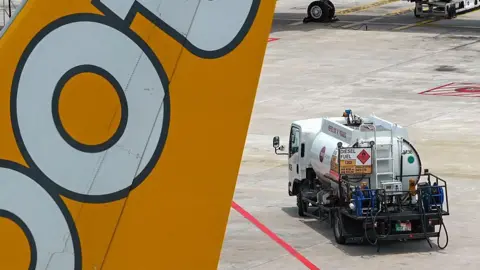
Singapore Airlines and its budget carrier Scoot have put up fares in response to the steep rise in jet fuel prices, a spokesperson told the BBC.
Fuel costs are the airline group's single biggest expense and accounted for around 30% of its spending in recent months, the spokesperson added.
The price adjustments "defray" but do not fully cover the increase in costs, the spokesperson said.
 Getty Images
Singapore's civil aviation authority also said it is postponing a green jet fuel levy which was due to kick in from April 2026, due to the impact of the Iran war.
The levy is meant to contribute to Singapore's purchases of sustainable aviation fuel, which is made from renewable sources as well as waste including used cooking oil and animal fat.
The aviation sector is a key part of Singapore's economy, making up around 5% of its gross domestic product (GDP).
What are other airlines doing?
On 24 March, the Philippines became the world's first country to declare a state of national energy emergency in response to the Iran war.
President Ferdinand Marcos also said that grounding planes due to a shortage of fuel is a "distinct possibility" after some of the country's airlines were told that they cannot refuel their jets abroad.
 Getty Images
Earlier this month, Vietnam's aviation agency warned that it could face jet fuel shortages as early as April because suppliers are delaying deliveries.
Vietnam Airlines has suspended several domestic flights.
The South East Asian country imports almost 90% of its oil from the Middle East.
Smaller carriers hit hardest
Experts have said larger airlines will generally have more options to deal with the impact of the energy crunch.
They are able to redeploy their jets to capitalise on the gap left by Gulf-based airlines which have planes stranded in the Middle East, said Bryan Terry from Alton Aviation Consultancy.
Singapore Airlines has added more flights to London, while Australia's Qantas Airways has increased the number of trips to Europe. Both are routes flown by Gulf carriers.
Major airlines are also able shift their long-haul jets to routes with stronger demand and customers who are willing to pay higher prices, Terry said.
Qantas said it is moving larger aircraft that it typically uses for US flights to routes to Europe, which has seen an uptick in demand in recent weeks.
Meanwhile, smaller carriers like Qantas' budget carrier Jetstar are cutting back some flights.
The rise in fuel prices will be toughest for smaller airlines, especially those that fly older jets that are less energy efficient, Terry said.
"They are navigating a crisis with fewer levers to pull."
International BusinessTravelSouth KoreaIran warAsia BusinessRelated
Are domes and spheres the future of entertainment?
Oil rises and Asia shares slide as Iran war enters fifth week
Why Chinese tech companies are racing to set up in Hong Kong
More from the BBCJust now
Everyday life in Asia is being upended by Iran war fuel crisis
Asia relies heavily on oil and gas from the Gulf, and shortages and higher prices are starting to bite.
Just now12 mins ago
Mayor quits over false Jewish ambulance fire posts
Dr Bharat Pankhania re-posted claims an arson attack was "an Israeli false flag operation".
12 mins ago7 hrs ago
How Pakistan won over Trump to become an unlikely mediator in the Iran war
Pakistan's role as intermediary in this conflict took many by surprise. But perhaps it shouldn't have.
7 hrs ago10 hrs ago
How Trump and the oil markets move in sync: A tango in five charts
Oil markets have been sensitive to Donald Trump's comments on the war. But are traders growing less responsive?
10 hrs ago10 hrs ago
Inside the cockpit of RAF tanker during defensive mission against Iranian drones
Defence correspondent Jonathan Beale flies onboard a Royal Air Force Voyager as it refuels jets in the Middle East.
10 hrs ago